Citrus processing produces large amounts of peel waste. However, this waste is rich in valuable compounds such as essential oils, pectin, pigments, and bioactive ingredients. As a result, efficient extraction technologies are increasingly important. Among them, supercritical CO2 extraction (SC-CO2) has become a key method due to its high efficiency, low temperature, and solvent-free nature.
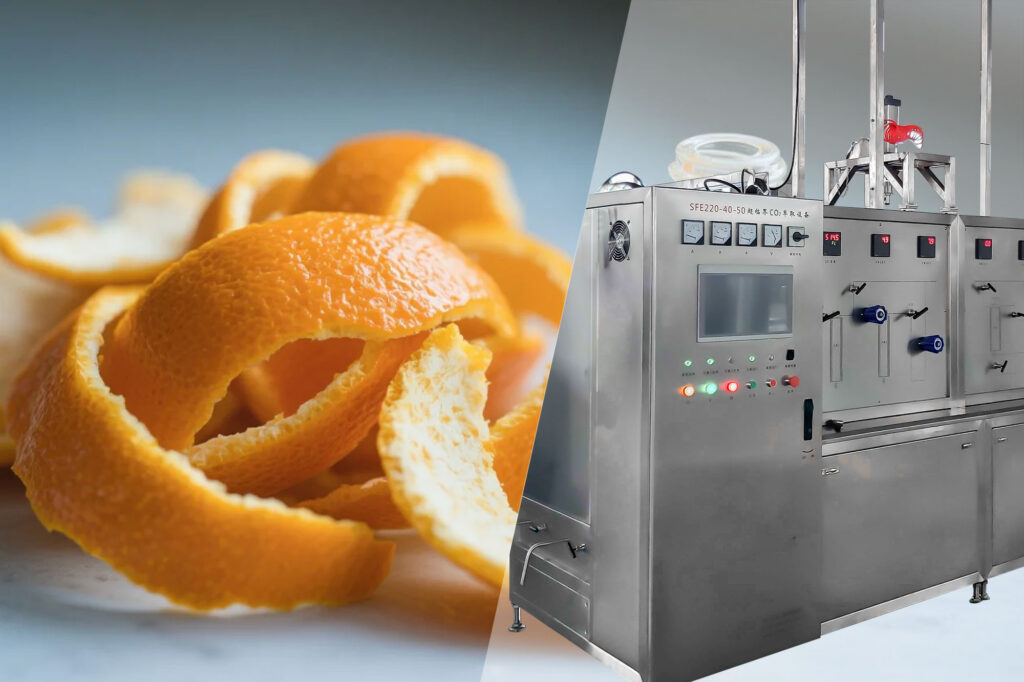
This article presents an optimized SC-CO2 extraction process for citrus peel essential oil. It focuses on the effects of extraction pressure, temperature, time, and CO2 flow rate. It also evaluates the use of ethanol as a co-solvent to improve yield.
Why Supercritical CO2 for Citrus Peel Oil?
Supercritical CO2 behaves like both a gas and a liquid. It has excellent mass-transfer properties and a strong ability to dissolve non-polar compounds such as citrus essential oil. Therefore, it extracts faster and cleaner than traditional methods.
In addition:
- It operates at low temperature, protecting heat-sensitive components.
- It leaves no solvent residue.
- It allows selective extraction by adjusting pressure and temperature.
- It enables higher yields compared with Soxhlet extraction.
Materials and Methods
Materials
- Fresh citrus peel
- 50 L supercritical CO2 extraction unit
- Ethanol as co-solvent
The peel was dried, milled, and sieved to 40–80 mesh. Each extraction used 100 g of citrus peel powder.
👉 Best-Selling 50L Supercritical CO2 Extraction System for Essential Oils
Experimental Design
The study used an orthogonal experiment to analyze four main factors:
- Extraction temperature
- Extraction pressure
- Extraction time
- CO2 flow rate
The extraction yield was calculated as:
Yield (%) = (Initial mass − Final mass) / Initial mass × 100%
Procedure
First, the prepared peel powder was loaded into a 1 L extraction vessel. After stabilizing the temperature, CO2 was pumped into the system. The pressure and temperature were adjusted to the target conditions. After reaching a steady state, extraction began.
Once the extraction time was reached, the essential oil was collected from the separator, weighed, and the yield was calculated.
Results and Discussion
1. Optimal Extraction Conditions
The effect of the four variables on yield (from strongest to weakest) was:
CO2 flow rate > pressure > temperature > time
The optimal combination was:
- Pressure: 15 MPa
- Temperature: 35 °C
- Time: 150 min
- CO2 flow rate: 23 L/h
Under these conditions, the extraction yield reached 10.164%, which is higher than the yields reported in previous studies.
2. Verification of Optimal Conditions
Five repeated tests using the optimal parameters produced yields between 10.102–10.225%, with an average of 10.150%. This confirms the reliability of the optimized process.
3. Influence of Single Factors
Extraction Time
Yield increases with time but decreases after reaching equilibrium due to mass-transfer limitations.
150 minutes is ideal.
Extraction Pressure
Higher pressure increases CO2 density and solubility. However, extremely high pressure reduces efficiency and increases cost.
15 MPa offers the best balance.
Extraction Temperature
Higher temperature reduces CO2 density but increases the vapor pressure of solutes.
Yield increases up to an optimum, and 35 °C is ideal for both yield and product quality.
CO2 Flow Rate
Increasing flow enhances contact with the material and increases yield. However, extremely high flow is limited by pump capacity and equipment stability.
23 L/h is optimal.
Effect of Co-solvents
Using ethanol as a co-solvent improved yield to 10.164%, significantly higher than using ethyl acetate.
Ethanol enhances solubility and reduces viscosity, improving mass transfer.
4. Comparison with Soxhlet Extraction
Under the same conditions:
- Soxhlet yield: 8.622%
- SC-CO2 yield: 10.164%
Although Soxhlet produces a more concentrated extract, SC-CO2 achieves a higher total yield, operates at loa lower temperature, and produces cleaner oil.
Conclusion
The study identifies a reliable and effective SC-CO2 process for extracting citrus peel essential oil. The optimal conditions—15 MPa, 35 °C, 150 min, and 23 L/h—provide the highest yield. Ethanol is the most effective co-solvent for enhancing extraction efficiency.
However, challenges remain. SC-CO2 equipment is expensive, not yet fully continuous, and requires skilled operators. Moreover, the natural oil content in citrus peel limits possible yield improvements. Future development should focus on continuous extraction systems and improved mass-transfer mechanisms.
FAQ — Supercritical CO2 Extraction of Citrus Peel Essential Oil
❓ What is supercritical CO2 extraction?
Supercritical CO2 extraction uses carbon dioxide above its critical temperature and pressure. In this state, CO2 behaves like both a gas and a liquid. It dissolves citrus essential oil efficiently and produces clean, solvent-free extracts.
❓ Why use supercritical CO2 for citrus peel oil?
Because CO2 extracts citrus oil at low temperatures. This protects heat-sensitive components such as limonene and flavonoids. It also avoids solvent residue and improves product purity.
❓ What are the optimal extraction conditions for citrus peel oil?
The best conditions found in the study are:
- Pressure: 15 MPa
- Temperature: 35℃
- Time: 150 min
- CO2 flow rate: 23 L/h
These parameters achieved a yield of 10.164%.
❓ Does adding ethanol improve the extraction yield?
Yes. Ethanol acts as an efficient co-solvent. It increases solubility and enhances mass transfer. As a result, the yield with ethanol was significantly higher than without it.
❓ How does this method compare with Soxhlet extraction?
SC-CO2 gives a higher yield than Soxhlet extraction and works at lower temperatures. It also produces cleaner essential oil because no organic solvent remains in the final product.
❓ Is this extraction method suitable for industrial production?
Yes, but with limitations. SC-CO2 equipment is expensive and not fully continuous. Skilled operators are required. Scaling up is feasible but needs process optimization and equipment upgrades.
❓ What types of products can use citrus peel essential oil?
Citrus oil is widely used in:
Natural cleaning products
Food flavoring
Cosmetics and personal care
Fragrances
Aromatherapy
❓ How does the CO2 flow rate affect extraction?
A higher flow rate increases contact with the material and improves yield. However, extremely high flow stresses the pump and reduces efficiency. The ideal flow in this study was 23 L/h.
❓ Can this method extract other compounds from citrus peel?
Yes. SC-CO2 can extract pigments, flavonoids, waxes, and other bioactive compounds. Co-solvents like ethanol help increase selectivity.
❓ What factors have the strongest impact on extraction yield?
From strongest to weakest:CO2 flow rate > pressure > temperature > time
Trusted by Global Clients
Our CO2 extraction systems have been sold to over 30 countries, including the USA, Germany, Thailand, and Australia. From start-up brands to well-known herbal extract manufacturers, our customers trust us for:
- Reliable equipment performance
- Excellent technical support
- One-stop turnkey solutions
- Remote installation guidance and training
Supercritical CO2 Extraction Market Report
Contact Us
Looking for the right supercritical CO2 extraction equipment for your business? Contact us today for custom quotes, technical consultation, and a free extraction process evaluation.
Email: [email protected]
WhatsApp/Phone: +86-134-8515-5519