Spice essential oils are natural aromatic oils obtained from spices such as seeds, fruits, flowers, roots, and bark. They are widely used in everyday products, including foods, seasonings, beverages, pharmaceuticals, and fragrances. The quality of spice essential oils largely depends on how gently and efficiently they are extracted, especially when the aroma compounds are sensitive to heat.
In recent years, supercritical CO2 extraction has become an increasingly popular method for producing spice essential oils. Unlike traditional steam distillation, this technology works at relatively low temperatures and uses carbon dioxide as a natural solvent. As a result, the original aroma and active components of spice essential oils can be better preserved, while the final product remains clean and solvent-free.
Why Supercritical CO2 Extraction Is Ideal for Spice Essential Oils
Traditional extraction methods, such as steam distillation, often involve high temperatures that may damage delicate aroma compounds. In contrast, supercritical CO2 extraction operates under mild conditions, helping spice essential oils retain their natural fragrance and flavor.
Another advantage is selectivity. By adjusting operating conditions, unwanted components such as waxes or pigments can be reduced, while the desired aromatic compounds are efficiently extracted. In addition, CO2 is non-toxic, non-flammable, and recyclable, making the process environmentally friendly and suitable for food-grade production.
Common Spice Essential Oils Extracted by Supercritical CO2
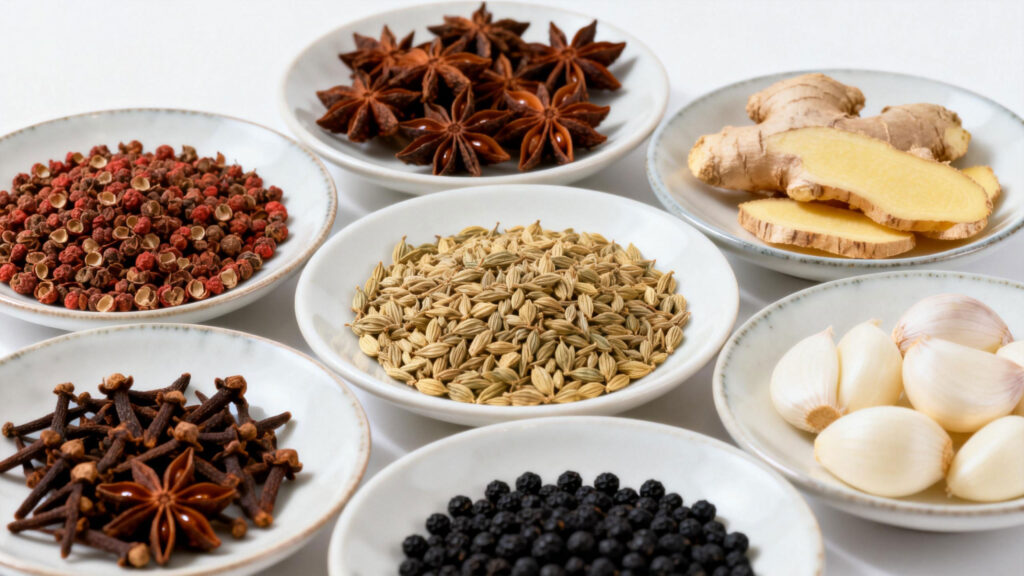
Many types of spice essential oils can be successfully produced using supercritical CO2 extraction. Chinese prickly ash essential oil, known for its numbing and citrus-like aroma, benefits from improved aroma retention when extracted under supercritical conditions. Star anise essential oil, rich in trans-anethole, shows higher purity and stability compared with steam-distilled products.
Coriander seed oil extracted by supercritical CO2 maintains a fresh and balanced aroma, making it suitable for confectionery and beverage applications. Clove bud oil, which contains a high level of eugenol, can be extracted with better composition control. Ginger oil obtained through supercritical CO2 extraction preserves its characteristic pungency and warmth, while garlic oil and Litsea cubeba oil show improved yield and cleaner aroma profiles.
Supercritical CO₂ Extraction Process for Spice Essential Oils
In a typical supercritical CO₂ extraction process, dried and prepared spice raw materials are placed inside the extraction vessel. Carbon dioxide is then pressurized and heated until it reaches the supercritical state. Under these conditions, CO₂ flows through the plant material and dissolves the aromatic compounds.
Once extraction is complete, the mixture enters separation vessels where pressure is gradually reduced. The extracted spice essential oils are collected, while CO₂ is recovered and reused. This closed-loop process helps reduce operating costs and ensures stable product quality.
Experimental Practice and Results
Using a laboratory-scale supercritical CO₂ extraction system, various spices such as ginger, coriander seed, star anise, clove bud, and Chinese prickly ash were tested. By optimizing pressure, temperature, particle size, and extraction time, high extraction efficiencies were achieved for most spice essential oils.
Compared with steam distillation, supercritical CO₂ extraction of spice essential oils consistently resulted in higher yields and better aroma retention. Ginger oil showed particularly high extraction efficiency, while coriander seed and Litsea cubeba oils also demonstrated excellent performance.
This experiment was conducted using a small-scale 10+2 L supercritical CO₂ extraction system manufactured by our company.
Conclusion
Supercritical CO₂ extraction provides a gentle, efficient, and clean solution for producing high-quality spice essential oils. By preserving natural aroma, improving extraction yield, and eliminating solvent residues, this technology meets the growing demand for natural and food-grade essential oils. As the spice and flavor industries continue to develop, supercritical CO₂ extraction is expected to play an increasingly important role in modern essential oil production.
Contact Us
Looking for the right supercritical CO2 extraction equipment for your business? Contact us today for custom quotes, technical consultation, and a free extraction process evaluation.
Email: [email protected]
WhatsApp/Phone: +86-134-8515-5519
Trusted by Global Clients
Our CO2 extraction systems have been sold to over 30 countries, including the USA, Germany, Thailand, and Australia. From start-up brands to well-known herbal extract manufacturers, our customers trust us for:
- Reliable equipment performance
- Excellent technical support
- One-stop turnkey solutions
- Remote installation guidance and training
Supercritical CO2 Extraction Market Report
FAQs
What are spice essential oils?
Spice essential oils are natural aromatic oils extracted from spices such as seeds, fruits, roots, bark, and flowers. They contain volatile compounds responsible for flavor, aroma, and biological activity, and are widely used in food, pharmaceuticals, and fragrances.
Why is supercritical CO2 extraction suitable for spice essential oils?
Supercritical CO2 extraction operates at relatively low temperatures and uses carbon dioxide as a clean solvent. This makes it ideal for spice essential oils, as it preserves heat-sensitive aroma compounds and leaves no solvent residue in the final product.
How does supercritical CO2 extraction differ from steam distillation?
Steam distillation relies on high temperatures, which may damage delicate aromatic compounds. In contrast, supercritical CO2 extraction offers better selectivity, higher yield, and improved aroma retention when extracting spice essential oils.
What types of spice essential oils can be extracted using supercritical CO2?
Many spice essential oils can be extracted using this technology, including ginger oil, star anise oil, clove bud oil, coriander seed oil, garlic oil, Chinese prickly ash oil, and Litsea cubeba oil.